Bandit

I dropped by Annís to trap whatever rodent was now living in her attic and to see what could be done about her screened-in porch. The porch is a bit bigger than the Kibbesí, but without the cool stainless steel tie rods.

In fact, there are no tie rods, nor a supporting ridge, and the existing collar ties were installed too high, which is why the walls are now spreading. I guess the good news is it lasted twenty-three years, but the bad news is it may collapse this winter.

As an aside, Adam, have you tapped your tie rods lately?

We talked about the new sun room, the one I might build in the spring, and whether it would be a three or four season living space with heat.

Anyway, the discussion of the room reminded Ann of Bandit, her ferret who used the porch as his protected playground. She had two ferrets, Bandit and Rocky, but Rocky died a year ago. Bandit, she told me, died two weeks ago. The thought brought tears to her eyes. More loss. Like water in her basement, only worse, Banditís passing was further proof that ìnothing is going right.î Maybe the sagging porch roof is too.

I jumped in (what would you expect?) and asked, ìHow about another ferret?î She said no, that there could never be another Bandit, and besides California (she has thoughts about moving) prohibits ferrets and … and then the tears really began to fall. She said something about Andrew, and I guess this is the place she always gets to.

I tried to tell her why she should get another ferret, or a cat, or a dog, or something to get attached to but I stopped myself.

This time I shut up and hugged her.

Birthday

phone.jpg
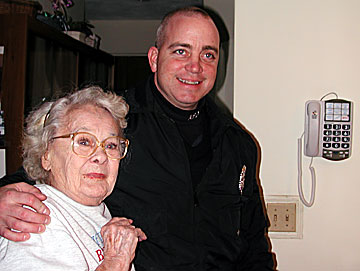
Susanís gift to Flo, for her 91st birthday, was a telephone with large, readable numbers, volume adjustments and programmable keys. The numbers Susan programmed didnít survive the trip from Minnesota so Matthew quickly reprogrammed them. The only problem? One touch pad retained its number – 911. And you know how that goes: ring, ring, ring….Matt answers.

ìDid you call 911?î

ìIt was a mistake, I was … ì

ìThere will be an officer at your apartment in a few minutes.î

Nieces pics as promised and Flo with her new beau.

Voice of Experience

by Adam S. Kibbe, guest blogger

ìSee, eyeglasses werenít unbreakable back then, so they wouldnít let Charlie enlist for combat.î The name delivered in a high-register version of that Nu-Yahwk drawl, to me usually fingernails on a chalkboard, but dismissable for the conversation we were having. ìBut he was determined, so he went into the medical corp and was stationed in Virginia Beach for the rest of the Korean War — excuse me, ìpolice actionî. It really wasnít supposed to be called a war, you know.î

I was speaking with Cathy, the mother of a good friend. Her husband, Charlie (Chahw-lee), had died some years back, and weíd attended his funeral on Long Island, along with various of the CT band. I was struck at the time by how well-regarded he was in his community there, how many people knew him, both currently and for decades, and could speak well of him and his many contributions. For several Thansgivings now we have invited our friend and her husband and mother to our house, as her only other sibling, Gary, lives far away, and theirs has become a quite small gathering. With ghosts.

ìI know. A U.N. action, wasnít it? And how long was he there?î I asked.

ìTwo years, I think — the rest of the war. I had just had Gary, and I know we didnít have Lynn until he got out.î Distant memories are often not set, but calculated against larger wayfaring milestones.

ìWasnít that hard, raising a child alone, and wondering how your husband was doing?î

ìOh, sure, but my mother was great — I wouldnít have made it without her.î Shoo-wah. Mu-thuh. Maiyd……….. ìIt was harder on Charlie, though — he saw all the guys who came back, not just wounded, but really badly affected by what they saw. Some things you canít fix with medicine. I know heíd rather have been able to actually go over there, but I think itís lucky he didnít.î

ìMy father was in that conflict, too. He was in the Air Force there — a mechanic, repairing….. some kind of airplanes. I always thought B-29ís, but he told me I had that part wrong. Iíve often wondered what being there was like for him.î

ìWell, if you want to know more about it, you should ask him.î

ìIíve started to before, but I didnít want to push it. I donít know how private it is for him.î

ìWell, the telephoneís right there — I bet theyíre home. Take it from me, you wonít always have the chance.î

And while I wrestle with the obvious, adult sense of her suggestion, ìHey, you guys, itís ready. Come and sit down!î Tricia says, sticking her head out of he kitchen to summon us to Thanksgiving dinner.

And we go.

new mittens.jpg

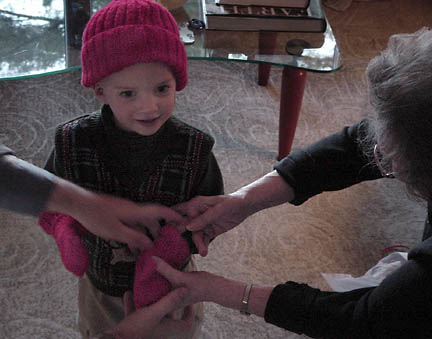
Our Thanksgiving houseguest, Cathy, helps Ivan try on the new mittens she knitted for him.

Thanksgiving

I didnít do it intentionally. I mean It was intentional, but it wasnít intentionally done for Thanksgiving. Matt and I went food shopping (How is that for being absorbed into the culture? Soon, Iíll be asking for bags.) last Tuesday night, and when we cruised through the frozen section, I bought, as I always do, whatever ice cream is on sale. This time, two half gallons of chocolate for him and two half gallons for me, both reduced fat. One butter toffee and one vanilla.

On Wednesday, when Diane was about to make her last Thanksgiving trip to Roche Bros., she, like the Hardy Boys queried, ìDo we have any vanilla ice cream?î

To which I proudly replied, ìI bought some last night. For the pies, right?î
Except, the pies had only that moment crossed my mind, but being the duplicitous snake in the grass (Dianeís sobriquet of endearment, subsequently adopted by all the sisters), I saw the brownie points and grabbed them.

After a long and festive Thanksgiving dinner, and the requisite amount of digesting time, I brought out my vanilla ice cream to accompany those pies: the pecan that John Lewis bakes and delivers every year, a mince meat pie Diane makes for Bob, a pumpkin pecan cheese cake brought by Katherine, and lastly, a traditional apple pie. Thatís when Charlie Hopkins, aka MR. VANILLA ICE CREAM CONNOISSEUR, walked into the kitchen, took one look at the carton, and shoutedî Light ice cream! Light ice cream! Why did you buy light ice cream? This is Thanksgiving; weíre supposed to get fat!î

His wholly unreasonable outburst caught me by surprise. I fumbled ìCome on, youíll never taste the difference.î As if one could pass arsenic past the Kingís designated taster. The guy drops dead or he doesnít. I thought, If I leave the lid open all the way, no one will read the label, and no one else will know.

About a minute later, Kate waltzes into the kitchen. ìLight ice cream?! Why are we having LIGHT ICE CREAM?î Loud enough to wake the dead in not so nearby Mt. Hope Cemetery. It was then that I knew it was time to flee.

Friday, I opened the vanilla ice cream container to see how much had been eaten, proving my point that no one would mind, and what did I find? Half scoops of ice cream nestled in a shallow pit of off- white. As though they had been scooped out, plopped beside the pie, tasted, then tossed back.


This year, I did not walk around with my camera glued to my right hand. I took a few pics, mostly without the cameraís worthless flash, and then stopped. Therefore, I donít want anyone living in Minnesota to holler, ìWhere are my two nieces?î

Gallery

Shadows in sunlight

Adam Kibbe

From a roughed-out clearing in the scumbled chaos whose colors are of mud and rage, a small, ominous crow lurks inertly. A scrap of aged newsprint bearing headlines of the occupation of Palestine looms up through the same thick, foreboding colors, its words tantalizingly obscured. Even the headline is incomplete, the publication’s dates invisible. Dried rivulets of vermillion are halted in their trickles down from a horizontal row of three widely-spaced wrought-iron nails driven into the canvas. Two cryptic letters hover at either side of the square, unframed piece, and several simple circles are scribed into the almost monochromatic millieu.

There is a new gallery just opened in Sudbury. It is on the second floor of an obscure, faux-Victorian retail building heavy with the ghosts of many failed businesses. But on this sunny November Saturday, Tricia and I find the space generously buoyed by light streaming in from leaded glass windows, the works well displayed in straightforward style without artifice. There is a distinct air of optimism, the owner bounding up and down stairs with cordless drill in hand, affixing yet more works to the walls of the not-quite-open third floor, pausing to greet the few visitors and encourage them to sign the guest book. No hint of sales pressure, just a love for what is on view, the pride evident.

We’ve made the rounds. It is not a large space, though the breadth of work is exciting and engrossing. The pieces include small and large sculpture, but are mostly oils or guaches, with a few quilts and giclee prints thrown in (no photographs, I note with ambiguous lack of reaction). Prices from tempting reaches to humiliatingly unobtainable. Many I like, one or two I quite love, and some, predictably, leave me mystified and unmoved. But I find myself once again standing before this one work and wondering what it is that draws me.

At the moment I can only remember the name of the piece, but not that of the artist. And I find this fitting — my experience of the gallery is certainly not this one artist, even this one piece, and should a reader find their way there, it would interest me to know if they would also find this piece, and find it notable. Thus I’ll leave even its title unannounced. The artist’s other works are less compelling, more contrived. Some of the elements I find powerful in this piece — newsprint, the scribed circles, and random letters — are found less successfully in other pieces, their power diminished by repetition. But this piece works, and it speaks of strong, dark emotion.

I am not alone in singling it out. In a writeup I found afterwards in townonline.com, the reviewer fleetingly describes a few pieces to give some of the flavor of what a visitor might experience, and they passingly refer to this work as “a collage where red paint bleeds from three nails embedded in the canvas”. Perhaps the salient hallmark, but not even a whiff of the whole. There is a cautionary tale here about the consequence of hatred and anger, and the almost monolithic use of excremental color seems to me a sentence of doom, of damnation. The red — perhaps deliberately not realistically the hue of blood — standing in as agony cutting through mute despair. Purest violence.

I don’t know that I seriously considered buying it, as I passed minute after minute thoughtfully before it, though I noticed its price and deemed it almost affordable. Would I want such a weighty, sombre piece malingering about my bright and beautiful home? It is too starkly dull to clash in any constant, superficial way, but its energy would stand out, its evocation of evil unwelcome in the sheltered vantage of denial we arguably foster by surrounding ourselves with our particular senses of beauty. A dangerous guest.

And here we are about to celebrate Thanksgiving in America. A now secular holiday debateably contrived and hyper-marketed, but ostensibly one celebrating nothing more than kinship and gratitude, with little in the way of retail subversion. But celebrated in a land so blinded by its riches that the concept of societal gratitude feels feigned. On a personal level, one does still muster sincere gratitude, though its expression may be scant in our daily lives. And so such a holiday welcomely puts us back in contact with some basic, humane touchstones. But in the scope of what this artwork addresses, it seems such gratitude may have gone missing.

No wonder, in lands where current horrors are wreaked nearly perpetually on brutalized souls as alluded to in the artwork. But here amongst the milk and honey, it’s an absence I find puzzling. And perhaps therein lies the value of such a work, and a reason for inviting it in to stand among the expressions of hope and exaltation. A contrast, but a complement; not in opposition.

It’s still hanging there as far as I know, and I don’t think I’m going back for it. Not that I think my ability to write about its effect on me passes for awareness or prophylaxia. Perhaps it is that age-old hesitance that something so stylized and “intentional” may only grate with time. Or that a second viewing might not find me open to its energy and it be judged more like its companion pieces — or worse, contrived and crude. Or maybe I’m just too attached to my comfy tower and its lambent ivoryness. Who’s to say?

There’s a new gallery in Sudbury. I look forward to the next exhibit — we signed the guest book. Maybe that piece will be waiting. Or maybe another admirer will find meaning or energy in that on which I lingered and buy it, take it home. Or maybe it’ll just get rotated out. Regardless, it’s a good gallery. It’s got heart, and it got to mine.

P.S. No way could I take a picture there, and I couldn’t think of a suitable placeholder, but I apologize for the graphic inadequacy of this entry……… Adam

Pennslyvania

ìMichael, I need to show you something.î

I was cutting through the yard of my elderly neighbor, Dolly, on my way to the protected wetlands project, and listening to her slapping her hands together, shouting, ìPumpkin, Pumpkin, here Pumpkin.î The neighborhood chuckles when it hears her calling her cat, but Dolly swears Pumpkin comes. Diane swears, itís not often right away. Incidentally, her cat had a crush on Skunk (our cat) and even now, over a year since he died, Pumpkin will sit in the yard staring, waiting for Skunk to come out and play.

ìSure, Dolly, whatís up?î

ìYou asked what Smitty did for a living and I want to show you.î

I walked up the three worn steps of her porch, and into her kitchen, which other than wear, looks just as it did when the house was built in the early fifties. Pink Formica counters, banded in Desoto-like chrome, impossibly soft vinyl on the floor, that gives back to your footfall. Dolly continued into her living room where we both sat, next to a coffee table with photos of her blonde, stunningly attractive daughter, Debbie, and Debbieís daughter, Tory. No pictures of Smitty, her husband.

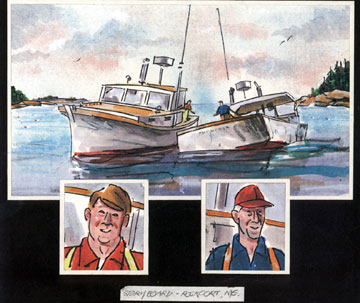
ìSmitty painted story boards,î Dolly said as she reached into a shopping bag full of foam core backed, watercolor illustrations.. She handed me one, then, pushed the entire bag at my feet. ìYou can have as many as you want. Take them all.î

I was still trying to remember what a story board was as I looked at the same hand that had drawn the picture of Matt, Tulum and me. Oh, yeah, advertising. His illustrated themes were then translated into glossy magazine advertisements.

ìYou donít want to give them all to me.î

ìSure, I donít need them.î

ìDolly, Iíd love to have these three.î I held them up so she could see which ones, ìbut I canít take them all. Theyíll get lost in my attic and no one will see them.î

ìNo one sees them here, either.î

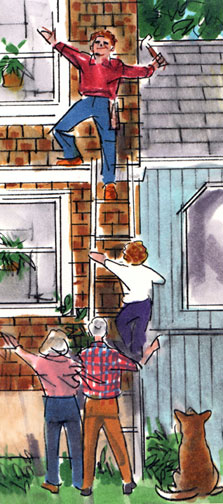
After posting Smitty’s illustration of Matt climbing the ladder, I tried to remember the exact date he died. Not out of morbid curiosity, but to help me determine how old Matt was. So I asked Dolly,

ìDolly, when did Smitty die?î

ìSeven years ago?î

ìSeven…no, Dolly, it was longer ago than that. It must have been eleven,
maybe twelve.î

ìIt wasnít that long ago, was it.?î

ìDolly, you donít know when Smitty died?î

Kind of a cruel question, I realized too late, but Iím perhaps too accustomed to my motherís impeccable memory. Besides, I thought widows marked their lives by the passing of their husbandsí.

ìNo, honest and truly, I donít.î Dolly uses ìhonest and truly ,î as often as Flo, ìOh, dear God.î Dolly stood up and walked upstairs, perhaps to the same room she keeps the story boards, and returned with Smittyís newspaper obit, sealed in plastic.

Dolly handed it to me and said, ìYou read it, I donít have my glasses.î

July 3rd, 1993

ìTen years ago, Dolly.î

ìIt was that long ago?î


On my last day in the wetlands, after which I could return to wearing colors that didnít match the marsh grasses, I was again taking a short cut through Dollyís yard when she came out of her house to ask:

ìMichael, I might be going to Pennsylvania, can you watch my basement? I donít like to go that far, but I should see my granddaughter.î She meant great granddaughter.

ìSure, you mean your sump pump.î Dolly keeps close track of the water in her sump pump hole, no matter how often I tell her the pump will do its job.

ìNo, the basement.î

ìSure, when are you going?î

ìThe end of the month. Or next month. I hate going that far, six hours on the plane.î

ìPennsylvania?î

ìPhoenix. It wasnít so bad when they lived in Pennsylvania. And Michael, you know I do think about Smitty.î

I didnít have time to apologize, or tell her I wasnít suggesting that she didnít think about her husband.

ìSometimes, when Iím falling asleep in front of the TV, Iíll call out, ëSmitty, tell those men to go home!í ì

Maybe I keep Dolly on her toes, but she does the same for me. I didnít want to sound like I didnít know what she was talking about, so I answered, ìLike his card playing friends were staying too late.î

Dolly looked at me quizzically. ìNo, you know,î and she put her fingers to lips, feeling the bump her doctor told her not to worry about, “Iíll be falling asleep and shout, ‘Smitty, tell those men to go home. ‘ î


Diane and I were talking about Dolly, and she was wondering why I would expect her to remember when Smitty died. I again said, because I thought that would become some kind of milestone. Women would count the years their spouse had been gone. I told her Ms Cass didnít know how long she had been married before her husband had died. In the hall, after class, she had said ìForty-seven, or forty-four.î Then she began to do the addition from the wedding date.

Diane – ìHow long have we been married?î

Me – ìHow long? Thatís not the point, Iím a guy.î Flustered, I continued, ìBut, I could figure it out. We were married in 1983, so thatís twenty years. Look, I donít know why I assume women keep track of these things, I just know they do, and when I hear otherwise, it confounds me.î I continued to blab on, and Diane sat patiently in the cane chair in front of our sliding kitchen doors, until finally she interrupted,

ìWe werenít married in 1983.î

storyboard_sm.jpg
View larger image

Feedback

Update on both recent stories.

Turn the Page (nee Dust Jacket), the instructor wrote: ìWith only a few revisions, this would be an absolutely first-class piece.î She wanted the point, that it was a weekend and therefore without well-trained staff, made more clearly, and a bit more information about Johnís duties. Otherwise, she got the dust jacket presaging the events and every other point I tried to make. There were many sentences underlined in red, with words like, ìfantastic, great and good.î

Sirens. ìThis is great.î
She liked the title (thanks to Adam who suggested it), she loved the phantom bear sentence (thanks to Adam for changing it from black bear), and ìthe sounds of this factory closing.î The big quibble was the last line, ìWhen he says ìIím all alone at last,î doesnít at last connote relief? As in ìfree at last.î

Iíd have to say, ìYep, what was I thinking?î


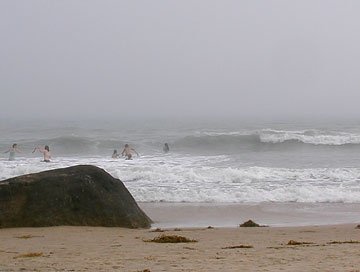
swimmers_sm.jpg
From the Vineyard, last summer.
View larger image

Sirens

Jim O’Brien offered to help paint his son Francis’s house. As they walked together, brushes in hand, wide-brimmed hats shielding their eyes from the morning sun, a phantom bear stepped on Jim’s chest, squeezing the breath out of him.

“Dad, you look awful, what’s up?”

“Don’t know, but I feel like I’m breathing through a straw, and the pains in my chest… . Look, son, this isn’t my way of weaseling out of helping you paint your house, but I think we’d better get to the hospital.”

Though the emergency room was crowded, Jim was whisked into the sterile white room with crash cart, IV poles and bright lights. Nervously, Francis chided his father. “Okay, forget the heart attack, I’ll do the ladder work.” And as Jim was about to reply, his heart stopped.

The room instantly filled with hospital staff. Francis dropped to his knees beside his father, while those around him struggled to coax another beat from his heart.

Francis’s lips almost touched the still, white lobe of his father’s ear, as if, like the enchanting song of the Sirens, he could lure his father back.

“Dad, I love you.”
“Dad, don’t go, stay here, we need you.”
“Daddy, please stay, please come back, please.”

Francis pleaded with his father to return as the room filled with other sounds: the mattress heaving under chest compressions, feet shuffling, orders barked, life-giving oxygen squeezed from the Ambu bag. Rhythmic, factory sounds.

“Back away,” the cardiologist shouted.

Francis stood, as his father convulsed under the defibrillator paddles. But then he was right back at his father’s ear, this time with song. Neil Young’s Old Man, but remastered.

Dad take a look at my life
I’m a lot like you
I need someone to love me
the whole day through

Ah, one look in my eyes
and you can tell that’s true.

Words from a son to a father, just as the son had heard from his father. Long ago. Songs, lullabies, made up stories.

“Dad, I love you, you know I love you, mom loves you. You’re helping paint my house, remember? Platinum gray with the red shutters. You come back and I’ll do the ladder work. I promise.”

I’ve been first and last
Look at how the time goes past.

But Jim wasn’t coming back. Francis felt the rhythm around him slow, voices reduced to murmurs, the sounds of this factory closing.

With his arms extended, hands touching his father’s face, Francis dropped his head between his elbows and cried.

But I’m all alone at last.

Digital Improvement

Update on Adam’s injury by Adam:

As many have asked…….

After getting lost and arriving a half an hour late to the surgeon, I sat in the front waiting room for another half an hour, then 45 minutes in the exam room (all supplied with interesting magazines). Finally the surgeon breezed in.

He said he was amazed at how well it was doing, asked my permission to remove the stitches, then, in fits and starts over 15 minutes, caused me some of the most minutely excruciating pain I can remember (something like 21 stitches, perhaps 7 of which were especially memorable). Afterwards, he apologized, and thanked me for my forbearance (my word), saying that people having stitches removed from fingertips and faces often pass out…….. Ouch, I say, ouch. Right, Mike?

Various gruesome milestones to which to look forward, but fervently thankful for all the good fortune and good wishes thus far.
But why no novocaine?
I love that you thought of that. I’ve been thinking about it since yesterday. But he never offered. I think if I had asked……. But honor bound by age and gender to grit and bear, I didn’t. And running almost two hours late, with 15 minute onset for such potions, I can imagine he was reluctant. Kinda taps into Mike’s dentistry story — now I know what they mean by “nothing”…….

Jeff

Iím writing my next assignment and Iíd be done by now if it werenít for my editor. She took the first version I handed to her, folded it twice to form more or less a square, tore it in two, then she handed it back. That was Monday. Monday night I began the second iteration of the same story and instead of tearing it to shreds, she said, ìWhatís wrong with sounding authentic?î

Now Iíve got to write the third version of this story and send it off by Wednesday night, whether it gets the in house seal of approval or not

hand_sm.gif
One of my all time favorites.
View legible image