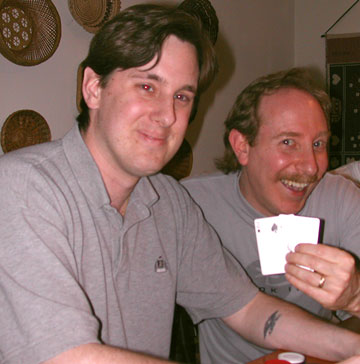
Stuck Truck

This, from my friend, Brian Pontz (left) . Brian worked at Channel1 and he was a part of the pokergroup, but now it seems all he does is move. He asked me for help and I said sure until I remembered I had to water my plants that day.

“The move was a disaster. We started at about 9:30ish and were done loading by 12PM. I made the mistake of driving the moving truck out back by the basement door to load up the basement stuff. The truck got stuck. We tried for a while and couldn’t get it out and couldn’t get a tow truck to come pull it out that day. So we had to wait till Monday. So the tow
truck came Monday and tried to pull it out but the moving truck was heavier than the tow truck so the tow truck couldn’t do it and started sliding on the grass. So then the tow truck got stuck as well. Then a second tow truck came and they anchored the stuck one with the second one which was on the tar and finally got the moving truck out along with the tow truck. Everyone was kind enough to come and move me in after work on Monday. We started at almost 6 and were done a little after 8. It cost $300 for the tow and another days rental for the moving truck….

I think the worse part was that my wife told me many times previously not to bring the moving truck out back because of the rain – that it would get stuck. Needless to say I heard about it later…”

*****************

I called my mother the other day:

“I was thinking about you last night. I’ve been taking antibiotics and I couldn’t remember if I’d taken my third dose. If you told us that we’d be ready to ship you off to the Mary Hotchkiss Hospital For The Mentally Deranged (from Sam Spade, July 17th, 1948). We hold you to much higher standards than we’ d ever expect of ourselves.”

Helen knows it and though she has never said anything, is not all that happy about it. Since her event we’ve all cast an anxious eye her way. This sideways confession made her laugh.

“Did I tell you about Jo Ann Resch and Father Lex?”

“No,” I said.

“Jo Ann brought us a grocery bag full of food Saturday night. While she was here, I told her that Father Lex had been by to see me while I was in the hospital. She asked me, ‘Helen, was that in body or in spirit?’ I said, ‘Why, body, of course.’ She said, ‘Helen, Father Lex has been dead for two years.’ I laid in bed that night laughing. I had confused Father Lex with my friend, Ted Temple.They are both priests and have both written books.”


tulip_red_2_sm.jpg
I know, I’ve become a one trick pony, but as I look at this I think to myself, Yeah, Diane is in Montreal.
View larger image

Pain Free

The pain in my jaw had reached that tipping point. Could I suffer through it, or would I have to jump in front of the first bus? The last three dayshad beenunpleasant , but for some reason, as I walked to the dentist’s office, the throbbing that had been a discordant cymbal player morphed into a Mephistopholean version of Stravinsky’s Rite of Spring.

I thought about my friend, Sharon, who developed RSD (Reflexive Sympathetic Dystrophy) after she separated her shoulder. My short, butchered form of this syndrome is that once the pain pathways have been established, the brain lays pavement for a superhighway. The initial injury heals, the pains remains, and as a free add-on, it gets worse. Now we have tandem tractor trailers rumbling up and down the Autobahn. In Sharon’s case, after failing to get relief from every pain pill on the planet, her inventive physician implanted a morphine pump which injects directly into her brain. The trucks now have softer tires.

I thought about Sharon, because I couldn’t think about anything else. When I approached Dr. Wang’s receptionist, she looked up at me and asked, “Are you okay?” I wanted to ask her, “Do you drive a bus?” But then I realized she wasn’t asking about the tears on my cheeks, but about the blood on my forehead.

Earlier in the day I’d stacked new wood on the railings of my neighbor’s porch, which I had been hired to rebuild. As I stood in the yard, the pointy ends of those boards happened to be slightly lower than my forehead. Every time I looked down to pull a nail from my tool belt, or bent over to retrieve a dropped tool, I’d bonk the board. The first whack, cushioned by my glasses, produced a single drop of blood between my eyes. The second raised an ostrich-sized egg way up on what my brother, Peter, refers to as the living version of Half Dome. The third whack, a direct hit on the ostrich egg, struck oil.

“You mean my forehead? It’s nothing.” I said.

She handed me the requisite forms to fill out.

“But you have blood all over you.”

I had some blood, but it was not all over. Mostly on my sleeves, which served as emergency gauze pads. I wanted to engage this trim, sparkly blue-eyed, raven-haired receptionist in conversation, but I could only clench my teeth.

After I’d scrawled through my health history, Dr. Wang ushered me into his office. I gingerly leaned back on his vinyl chair, and then a very strange thing happened. The pain disappeared. So completely I couldn’t identify the offending tooth. Nor could Dr. Wang, but boy, did he try.

He tapped each tooth with the heavy metal handle of a dental probe. He began with my first upper canine and worked back. Clang. Nothing. Clang, nothing. Clang, still nothing.

“Is it heat sensitive?” He asked.

“I can’t even breathe in without pain.”

He yanked his air gun from its cradle and hosed down the upper right side of my mouth. Nothing. He reached behind where I couldn’t see and returned with an instrument he dipped in ice, and then placed on each tooth. Still nothing. Finally he applied a similar probe, but this one with a red hot end. I could hear sizzling as moisture evaporated from the enamel, but I felt no pain. I thought about Dustin Hoffman in the movie Marathon Man.

Dr Wang smiled; not a malicious Zell-like smile, but a caring, curious one. “This is like going to the doctor and having your symptoms disappear.” Take out the “like,” I thought, this is the real thing.

“I took Nuprin before I left. Do you suppose that’s the problem?”

“It could be. Is that Ibuprofen?”

I still had the bottle. I reached in my pocket, past my keys, assorted nails and loose change,and I pulled it out. There on the label it said – Ibuprofen.

“I guess the anti-inflammatory did its thing. I’d been taking aspirin without much relief, but I talked to another dentist today and she said to take Advil, so I switched.”

Frustrated, Dr. Wang held up the new x-rays and explained which tooth he speculated needed the root canal. The one capped by silver.

“I could do a root canal on this one, or you could come back tomorrow when you’re certain which tooth hurts.”

I opted for door number two.

**********************

Next week: That Filing Feeling

He’s For Me

dans_parents_sm.jpg
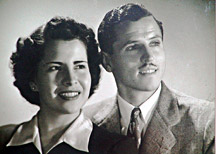
Bertha and Emerson Downing
View larger image
I remember when I first met Emerson. I was at work, and my aunt called me and told me to come home early, because a Gringuito was coming in answer to the ad for the room, and I was the only one who could speak English.

My mother, sister and I were living with my Aunt in a brand new house she had bought with lottery winnings, on Mazatlan 161 (Colonia Condesa, right near the Angel). The house had two floors and three bathrooms, and she advertised one bedroom and bath for rent to supplement her income.

I came home early; it was raining. I peered out of the Venetian blinds waiting for him. He arrived in a little beat-up old Ford. The minute he stepped out of the car, I said “He’s for me!”.

He came into the house; we showed him his room; he rented it on the spotÖand he never left. Poor Bolton Mallory — I dumped him right away.

This is the house we were married in. We did not get married in the church because Emerson was not a Catholic. His best man was Oliver Ormond, an FBI friend from Texas, who was later killed in a plane crash. Only my side of the family came to the wedding.

He's For Me

dans_parents_sm.jpg
Bertha and Emerson Downing
View larger image
I remember when I first met Emerson. I was at work, and my aunt called me and told me to come home early, because a Gringuito was coming in answer to the ad for the room, and I was the only one who could speak English.

My mother, sister and I were living with my Aunt in a brand new house she had bought with lottery winnings, on Mazatlan 161 (Colonia Condesa, right near the Angel). The house had two floors and three bathrooms, and she advertised one bedroom and bath for rent to supplement her income.

I came home early; it was raining. I peered out of the Venetian blinds waiting for him. He arrived in a little beat-up old Ford. The minute he stepped out of the car, I said “He’s for me!”.

He came into the house; we showed him his room; he rented it on the spotÖand he never left. Poor Bolton Mallory — I dumped him right away.

This is the house we were married in. We did not get married in the church because Emerson was not a Catholic. His best man was Oliver Ormond, an FBI friend from Texas, who was later killed in a plane crash. Only my side of the family came to the wedding.

Lightfair

With permission, I’m posting this email Adam sent to both me and his father.

The New York Lighfair was enormous, though lacking some familiar names. Lots of big names don’t show a booth, both because of industrial espionage, but also the cost — the bigger you are, the harder to distinguish yourself, so the more it costs. $30k – $50k seems like the low end of the high end. Didn’t see any of those factories’†people either — they sometime send folks to walk about just for the sake of being there politically.

The trip was good, though not especially “productive”. We took the Acela high-speed Amtrak train†down from a stop on 128/95 south of Boston –†3 hrs. 15 min. there to Penn. Station. And just days before they were grounded for brake problems. Rode down sitting with a rep friend†and Tracy from Ripman, who’s just gotten engaged, her boyfriend proposing underwater while scubadiving in Curacao!

Dropped our luggage at the Times Square Westin (not to mention dropping several hundred dollars) then a free shuttle to the Javits Convention Center on the lower West Side. Walked onto the floor about noon, where we were to meet a German manufacturer for lunch.

There’d been a change of plans, though, so no lunch. Invites to Germany on their dime at some unspecified time, but no lunch. Despite grumbly stomachs, we decided to just hit the aisles and later bought savory crepes (of all things) from a sales floor vendor. Huge show, with hundreds of booths. Lots of interesting new stuff, though little approaching revolutionary. LEDs have really hit their stride, showing up in everything from track fixtures and outdoor spotlights to neon-like linear things and television-like panels. Much of it kinda silly, really, though some of it quite useful and clever. And Chinese firms were as usual†dense around the fringes, making few contacts that I could see but engaging in the aforementioned subtle espionage. Luke even saw someone thrown off the floor for unauthorized photography. And China itself (or its trade commission or something) took†several whole “blocks” of booths, a first in my experience.

Show closes at 6:00 each day, and after waiting in a huge line for the shuttle bus and changing back at the hotel, we were off for the first of the night’s attempt at three parties, at the Guggenheim, arriving there about 7:30.††Few familiar faces, and the museum devoid of art for the first four floors due to an installation in the atrium — a 90-degree outside-corner mirrored tower reflecting the Frank Lloyd Wright spiral back on itself, with small panels of neon-green colored taped applied as dashes to the insides of the spiral rail/walls for visual clarity. Clever for about 5 minutes. Then funny for the funhouse mirror moments for†a few minutes more, and then the stark whiteness of the place begins to gnaw, the black-clad human ants insufficient and equally stark counterpoint. Tasty hors d’ouevres and free drinks kept us there a half-hour or more, but then we were off for the next party, thrown at storied The Tavern on the Green in Central Park.

More mirrors, but a†whole other experience. Zigzagging paneled halls of faceted mirrors confuse the eye but ultimately†lead you into a brashly frilly open space full of white latticework gingerbread and drippy crystal chandeliers, where hundreds of people were hoovering up extensive tablefulls of food and free booze, a few dancing in the central greenhouse atrium (to cheesy Abba covers as we arrived, almost spinning on our heels and departing in response). Many hundreds more were in the†equally drippy†garden outside, where the huge trees are wrapped trunks-to-branch-tips in glitter-light nets. We’re told that over 700 showed up, about double the expectation, making a harried night of it for the waitstaff.

Some compatriots and old friends were smoking cigars outside (like everybody else who for some reason finds that habit a social necessity — not that you’d get any truly fresh air in NYC, but you had to go inside for it there), so we stayed to talk. After about as much as we could take, though, we were rescued by a phone call from the third party, which was nearing its close at 9:30, our friends about to head out for dinner. So we scooted by foot a couple blocks down to the Time Warner complex on Columbus Circle, a fascinatingly massed almost twin tower of curved glass, up to the 15-minutes-of-fame-trendy new Stone Rose bar, where I managed most of a quick Glenmorangie port finish, one icecube, which beat the Red Label and Dewars from the last parties, before wistfully leaving it half-full as the last member showed up and we were off for dinner.

Which was at one of New York’s most famous steakhouses. And me a vegetarian. One walks in past the deliberately windowed meat curing room full of darkened slabs of aged and tagged meat. A macabrely repetitive scene of bizarre simplicity, floor to ceiling beef. Despite that, we forged ahead, and later, my ordering the “Seasonal Vegetable Platter” was a rollicking moment of irony, the wine good, the stories entertaining, ranging from my growing up in Venezuela to one of the reps’ it-only-gets-worse tale of misbehaving and being serially thrown out of a Jimmy Buffet concert for his increasingly insane attempts to get back in after the first transgression forcefully separated him from the clients he was entertaining.

It wasn’t all fun and games, as some business and politics were slid in subtly, but after we left, we declined the last stop at a swanky bar and instead wandered back to our hotel through Times Square marvelling at the excess, and hit the hay about 1:00 a.m.

We also declined our last offer, breakfast at The Rainbow Room the next morning –†probably a mistake, but Lukas, father of two small children, never gets to sleep in, and that seemed more enticing. So he and I went to a small cafe for a leisurely breakfast, then checked out, and got back to the Javits about 11:00. Many more familiar and long-lost faces, and more in-depth conversations, the pressure to see it all dispelled by the first day’s efforts. I was less effective than Luke, staggering about on legs that were quite done yesterday, thank-you-very-much, and randomly hitting up interesting booths. Our separating both days was good strategy, though, as there was little overlap in our efforts.

Perfunctory lunch there again, some political intrigue to do with reps and firings and Machiavellian scheming, more old friends, then off for Penn Station for our 7:00 p.m. train., home about 11:00.

Soul Mates

wendy_jean_sm.jpg
Wendy-Jean
View larger image

After a weekend of salty sea air and sumptuous seafood, we are refreshed and ready for anything that may come our way.

Wednesday, Flo will be discharged from Rivercrest and Diane will move her ( I’m in charge of the TV) back to Concord Park. We expect a rousing welcome from staff and residents.

Our friends’ house on the Cape had cable TV and we watched two new releases, both of which I recommend: The Fugitive and The Bourne Identity.

Diane’s best meal? Raw Oysters on the half shell with crab cakes and a glass of Rosemount Estate. Mine? Scallops sautÈed with capers.

You’ll be happy to know that I talked to only one person, Richard, the owner of one of Chatham’s oldest and most respected galleries. With a kelly green cable-knit sweater over a blue pin stripped shirt, weejans, and black rimmed reading glasses far down his nose, I thought, here is someone with whom I have nothing in common. Until he misunderstood one of my comments.

“That’s a good price for the Falconer painting!” At fourteen g’s, I meant, don’t be ridiculous. But he heard it as it reads. On our way out, I said, “I hate the traffic now and it isn’t even the summer.” He replied,

“This is a town of five thousand which grows to thirty thousand in July. When the crowds descend, I take my two most expensive paintings and put them in the window. That keeps the “I Am With Stupid” T-shirt crowd from coming in and dripping their ice cream all over my art.”

Thaw

river_to_be_s.jpg
Adam sent me this photograph about a month ago. This river to be is now all river.
View larger image
Matt is on Spring Break in Florida and we are going to be in Chatham on the Cape until Monday. No computer access and no updates unless the Benedict Arnold Twins, Adam and Dan, chime in.

All In The Family

When you read this remember when my grandmother was born – a long time ago – and where she grew up – the southwestern part of Missouri.

Helen and I are waiting to see her liver doctor.

“What do you see?” I held up my fingernails.

“You’re not anemic.”

“That’s right. And do you remember when you looked at my fingernails and said I was?”

“Vaguely.”

“Back in 1970, when Diane and I were Macrobiotics. You said I was anemic. I said ‘Bullshit.’ But you were right, just like now when you said I should have checked in with the receptionist. We wasted twenty minutes because I thought they’d see us sitting here.”

Sitting here, waiting for Dr. Schneider. Our appointment had been for 2:10 and now it was 3:10. I owned twenty of those minutes, but he owned the rest. Helen was exhausted, but as in all things, there was good. Helen told more stories.

I continued.

“You reminded me of Dr. Phillips. He talked to me, and with no lab tests, diagnosed my hypoglycemia.”

“You said I sent you to a psychiatrist. That he didn’t even listen to your chest.”

“ A smart aleck, even at thirteen? I should cut myself some slack. Maybe I was being funny. I still can’t believe he figured that out.”

“Dr. Phillips knew my mother had atherosclerosis of the arteries in the brain. He said she had a classic ‘frozen mask.’ ”

“And he was right. Well, she had dementia, but who really knows why.”

“I told my mother and she said he was just a fat Jew.”

“Yeah, and… .”

“That’s what she said.”

“And… .” My mother, and my father for that matter, had they lived in Selma, might have marched with MLK. I needed some kind of acknowledgment that what her mother was saying was off the wall.

“She was half right. He was a Jew and he was overweight.”

“And…come on here.” I needed tenderizer for this tough piece of meat, but I wasn’t getting any.

“You know what Francis Gallagher used to say?”

“Do I want to know?”

“He said he would be sure his doctor was a hebe.”

“Classic Archie Bunker.”

“He said a Jew would have to work extra hard to get into medical school. I didn’t know what a hebe was. My mother had a bridge club. She told me one of her neighbors, a Jew, wanted to join. She asked me what I thought, because she didn’t know any Jews. I told her that would be a good reason to invite that woman to join. She looked at me and said, ‘You always were peculiar.’

“Did your mother have a sense of humor?” I asked this only because my older brother, Brian, thought she was a bit on the stern side.”

“She did, and she told this one joke, but she couldn’t tell it right. It goes like this. There was an evangelist. Her name was Aimee Semple McPherson. ( I heard, Amy Simple McPherson but when I looked it up Google asked me if I really meant Aimee Semple). My mother would say, ‘What do you call an Aimee Semple McPherson salad?’ The answer was, lettuce cutup without dressing. But she would say, ‘Lettuce cutup without Mayonnaise.’ Everyone would laugh.”

“Wait a minute. Lettuce cutup without dressing? This was a joke?”

“It was slightly vulgar”

“Vulgar? Aimee Semple …Lettuce cutup without dressing?”

Helen laughed so hard, she turned red. “You are as bad as my mother.”

“Lettuce cutup…”

She slowed it down for me, enunciating each syllable, “Let–us–cut–up–with–out –dressing.”


An update from rakkity:
I just got an email from KT today. She slept under the stars in the Moroccan Sahara desert the day before yesterday, then hopped on a camel and rode back to town while the sun rose. She loved it. Today, she’s got her nose back to the scholastic grindstone in Sevilla.

Old Time Radio

Chris is tall and his grey hair, parted on one side, complements his blue eyes as if it were dyed to match. He looks like he could be Ted Kennedy’s son, and when he told me his mother knew Ted, I thought, okay.

“I don’t need much, a couple 1×8’s of quarter-sawn white oak.”

As Chris punched the keypad of his calculator, multiplying board feet by price, I asked, “Do you remember old time radio?” He paused and looked at me quizzically, as if the fifty years had to be traveled in real time.

“The Shadow, Ellery Queen, Dragnet, Sam Spade.Ö. I bought a three CD set from Willow Books, and now I can’t get out of my truck. “

“No, we were TV watchers.”

“How old are you?”

“Fifty-one; my brother, Mark, is fifty-three.” He and Mark run this business, a hardwood outlet. Suppliers ship rough cut lumber which is then dressed to order in the brothers’ mill.

“That was the beginning of TV. You would have listened to the radio.”

“The only thing I remember was the Dickens tale on WBZ. They played it two years in a row on Christmas Eve. It helped me get through the nightmarish night before Christmas Day.”

“I’ve never heard anyone call it nightmarish. Exciting, over-stimulating.Ö.”

“Maybe I exaggerate, but we could never fall asleep, thinking about presents waiting under the tree. Once my mother gave us sleeping pills.”

“Sleeping pills. I’d be afraid to imagine what they might have been.”

“You know, I don’t even know if they were sleeping pills. Could have been anything.Ö.”

“Placebos.Ö?”

“Like aspirin. That was the only time she gave us something to sleep. I wish I had asked her what they were, but I don’t think she would remember.”

“My mother would. She remembers everything.”

“Not mine. She had late-in-life depression which affected her memory, and she had electroshock therapy.”

“This was before Prozac?”

“No, it’s only seven years ago. There is a small percentage of people those medications don’t work on, and my mother was one. They contain speed, or something like speed, and it made her agitated. Instead of depressed and lethargic, she was depressed and hyper. But don’t think of mad scientist electroshock.Ö.”

“I know. My wife works at McLean.”

“It made my mother feel much better, but the side effect is it erases your memory. Not long term, but your short term memory.”

What is it about me that gets people to reveal this stuff? I don’t know that I’d even tell a friend my mother had electroshock. I could have gone on, but I changed the subject. “Are those your girls?” Portraits of two high-school age girls, both redheads, hung on the wall behind Chris.

“No. They are Mark’s, which means they are my nieces. The one on the left is sixteen and a half, just got her driver’s license.”

“Uh oh.” My father worried when we got our driver’s licenses, and even with safer cars, that worry was passed down.

“And she had a fender bender.”

“As did my son, Matthew, not long after he got his license. It seems to be a rite of passage.”

“She was driving in the snow. She slid right through an intersection.”

“Matthew has done that, too, without running into anything.”

“But she uses the snow as an excuse.”

“Let me guess. She said she was driving soooo slowly.”

“But not slow enough.”

“I know. It’s as though teenagers have established a minimum speed, below which they won’t go, and if they have an accident, it is not their fault. Was she alone?”

“She was, but she doesn’t pay much attention to the law about not driving with other kids for six months.”

“Doesn’t pay attention? Don’t you tell her not to?”

“We compromised. That is one law very few kids obey. I told her if she drives with kids it can’t be at night and she has to be extra careful.”

“That is your compromise? Think about the cops that stop her. They don’t compromise anymore. There is no longer any we’ll-make-sure-they-get-home-safely stuff. It’s all leg irons and handcuffs. I hate the rigid world Matthew inhabits.”

“Don’t get me started on that. We’ve lost control of our police departments.”

“That’s a great way of putting it. It’s all punitive.”

I could see my morning disappearing inside this two-room building.

“We could go on and on, but I’ve got to get back to work.”

***********************

My day’s project was to add connecting side rails to an antique head and footboard. I had the matching lumber, now all I needed was the hardware to connect the pieces. Next stop, my local lumber yard.

“Mr. Miller!”

“Jim.”

“What can I do for you?”

“I need bed rail hardware.’

“We don’t have any.”

Jim is sixty-two, has a lived-in body and acts at work as he might at home. He is so pleasant and so casual, I expect him to pop a slice of pizza in a nearby microwave and offer me half. I’ve known Jim for years and have learned that he is divorced, has two sons, and a daughter and two grandchildren. He claims his job killed his marriage. Or should I say, his jobs. For the last twenty-four years he worked two: one behind a desk, selling building materials, and the other, evenings and nights, patrolling the streets as a town cop.

“Okay, forget the hardware, tell me more about your two jobs. I can’t wrap my brain around the lack of sleep thing, and even worse is the space issue.”

“Like outer space?”

“Inner space. When I get home after work, I kick my dog, my wife and my kid in that order. You don’t go home, you go to another job. What do you kick?”

“Remember, I was doing two entirely different things.” Jim ended the sentence with a lilt, as if the change in tone added emphasis.

“Oh, yeah, that would do it. Go from your day job to your night job, the one where you carry a gun. And this is on how many hours of sleep?”

“Four, but never all at once. And you know, it never bothered me. My doctor couldn’t understand it either, but he said I was so healthy, to keep on doing what I was doing.”

“Here’s a question for the old time cop in you. I was talking to Chris down the street, just before I got here, and we both agreed we’ve lost control of our police departments. Nothing is settled in a friendly fashion. Like the old days. You remember the old days.”

“You mean domestic disputes?”

“No, we were talking about driving…but, yeah. That too.”

“You can’t anymore.”

“Can’t what anymore?”

“Walk away from a fight. It’s the liability. If I walk into a situation, I own it. From the moment I arrive, it’s on my shoulders. If I leave and someone gets killed, I’m in trouble.

“You can’t stop the fight, dust your hands off, and say goodbye?”

“No. If I get a call and it’s a couple, one of them is going in. No matter what, and I have to decide who. I got a call once and it was a woman beating her son. She had pulled the glass and wooden shade off a ceiling fixture, smashed it on the floor and was hitting her kid with the wooden slats. She said she was trying to teach him who was boss. I had to take her in.”

“So you go from child abuse to, ëI don’t have bed rail hardware?’ No stops at Jim Beam’s house, let alone your house?”

“I don’t drink, and that lady hitting her kid is far from the worst. I had a seventeen year old point a gun on me. He kept me at bay for forty minutes.”

“And then what?”

“He put the gun to his head and pulled the trigger.”

Spring Flowers

ho_flowers.jpg
Helen, after her first office visit, admiring her flowers.
Yesterday reminded me of one of the camping group’s fall bushwhacks through the Maine woods. We have a plan, a view, we have a destination, a mountain top, but we never quite get there. A rocky outcrop, an opening through the trees, a glimpse of the lakes below, a settling for less than what we desired.

In the shortest form possible, her primary care physician said, ‘Move.’

Her gastroenterologist said she might have autoimmune liver disease or Primary Biliary Cirrhosis, but we won’t know until we do more tests.


Dr. Bieker. ‘Do you have a living will?’

Helen. ‘No.’

Me. ‘I am her health care proxy.’ I’m pretty proud of this now that Chris tells me it means I’m her favorite.

‘Dr. Bieker to Helen. ‘Does he know what you want?’

Me. ‘I do. At the first excuse, she wants to see what’s next.’

Dr. Bieker. ‘Many people are afraid to die.’

Me. ‘Not this one. she is not afraid enough and that’s a problem.’

Dr. Bieker. ‘And some people reach a point where they have had enough.’

Helen smiled. I knew she wanted to raise her hand.

My Business

As I sit here my mother tells me stories. Because “here‚” is at her fabulous new computer, I try to write them down as fast as she speaks, but I get behind. She’s a terrific story teller with a scary memory, and if I could keep up, I’d have no editing to do. Today, I’m not in a spiffing up mood. Here’s today’s, ragged edges and all.

But first, a short update. Tomorrow we have Helen’s first doctor’s appointment at 9:30. It’s with her primary care physician, the one who will tell me Helen has to move to be closer to her children. Joan wants me to say, “My sister, Joan, would be happy to have her parents move in with her, and she will do everything humanly possible to facilitate it. Michael, however, thinks it’s okay if his mother dies a miserable and neglected death in bed in her computer room.”

At 2:30, we drive back to the same building to see the gastro-enterologist who will tell us if the Prednisone is keeping Helen’s auto immune liver disease under control. Joan, wants me to ask him about interferon lozenges.

On to today’s story:


“When Ron Coleman killed himself, the police wanted to interview me. I told them, no, I didn’t want the police driving up and down the street in front of his house. “

“That was the guy across the street?‚”

“Oh, you remember. Ron came over asking for money and we gave him a check for forty dollars. I made it out for twenty and he looked at it and said, “Couldn’t you make it out for forty?’ I said, “No,’ but Mack gave me that don’t-be-so-stingy look. Later that day the bank called to ask me if I had written a check for four hundred dollars. Anyway, the investigating detective wanted to come to our house to interview us. I told him, “I do not want you parked in front of my house because I live across the street from these people. They don’t need the embarrassment.’ He said, “I’m not sure it’s any of your business.’ I said, “I’m not so sure it’s not,’ and then I said, “Why don’t I meet you at the bank?’ His answer, “I don’t have time to do this.’ I’m getting impatient now, so I asked him how about if we meet at the bank in two hours, and the detective agrees, but he doesn’t show up. After I got home from the bank, I called him in his office to ask why he didn’t wasn’t there. He said he didn’t feel like it. He wanted to meet me here.”

“Anyway, I turned the news on the next night and there is a story about a man found dead in an abandoned house of a drug overdose. It was Ron. I had to call his brother to tell him what happened. As much as I knew. He was greatly relieved by my call because he was afraid he had caused his brother’s death after he stopped giving him money.‚”