The Character

I’d just gotten home from work. I was chillin’ in front of my computer, before my shower, before Diane arrived back from wherever she was, and before our trip to the bookstore, Borders. Diane’s Lebanese born car salesman had convinced her to buy language tapes to improve her French (doesn’t that sound like something that would happened to me, not her?) and I needed a few more hours of radio mystery.

Let me add – this had already been one of those weeks. For both of us

Ringy dingy.

“Is this the Florence Canning household?”

“Close enough.”

“Then you are… ?”

“Her son-in-law.”

“This is Kim from Dr. Paparallo’s office. We have the report on today’s CAT scan. Florence has a fractured hip. She needs to be taken to the emergency room at Emerson.”

“Why? What will they do there? We did that last Saturday after her fall on Friday.”

“That’s what the doctor wants.”

“She has some mobility, she is in rehab… “

“But you have to take her to the emergency room.”

“I don’t mean to be argumentative, but why not call an orthopedic surgeon to see her?”

“Dr Paparallo wants you to take her to Emerson. She has a non-displaced fracture of the greater trochanter and it’s severe enough that she should be seen in the emergency room.”

“But then what? We’ve been through this before. They looked at her and sent her home. Now that they have more information, what will they do?”

“She may need surgery. I don’t know.”

Kim won. I couldn’t argue anymore. I knew that Diane, after yet another week of medical calls and today’s CAT scan on her supposed day off, might just complete her core meltdown, which would be pleasant to watch compared to how I knew Flo would react.

“Okay. We have some things to do (I had to find Diane), but we ought to be there within the hour.”

“I’ll call and tell Emerson you are coming.”

Maybe you’d like to call and tell my wife.

The emergency room bustled with business, but Flo didn’t have to wait long to see Dr. Sam Sockwell. Maybe because, in my own fit of pique, I wheeled her through the door marked “Ambulance Entrance Only,” and not the one further away, “Emergency Room Patients.” Wheeled is a misnomer. I gave her a shove and she glided through both automatic doors, and arrived without escort at the front desk, behind which all the doctors and nurses, not the admitting staff, buzzed. Even stressed out Diane, who had to whip her head around to find her mother, laughed.

Dr. Sockwell is tall and thin and his light brown hair has just a touch of gray at the temples. He is direct, very polite and though he has no accent, you know he is not native born. He told us that Flo’s fracture was similar to her right hip fracture of two months ago, and we had to decide if she would get proper care back at good old Concord Park. If Flo were at risk of falling, she would have to be admitted to Emerson, and then shipped back to Rivercrest or another rehab facility.

“Can you be careful?” Each time Dr. Sockwell turned from one of us to talk to Flo, he’d bend down and make real good eye contact. Yes, he raised his voice some, but not a lot.

“Oh yes.”Flo answered. I knew how much Flo wanted to go back to her place and I knew she was going to serve a whole platter of yes’s. I bit my tongue. We all wanted her back at “the hole.”

“Are there people at Concord Park to take care of you?”

“Oh yes.”

“The hole” had morphed into God’s gift to the elderly.

“Will you ask for help?”

“Yes. I will. They told me to pull that thing (her call chain) whenever I needed to, but I thought it was just for emergencies. They said, ‘Pull it anytime.’ I said, ‘You mean, even at 2 AM ?’ They said, ‘Yes.’ “

Diane, eager to make sure Dr. Sockwell knew who he was dealing with, interrupted Mrs. I’ll-Be-A-Perfect-Angel.

“Last night my mother used the commode, but she couldn’t stand it sitting at her beside, so she got up and emptied it.”

Dr. Sockwell, who had been laughing at Flo’s answers before this, straightened up, turned away and muttered, “She’s a character.”

Flo said, “Who’s a character?”

Dr. Sockwell looked down and said, “You are.”

Polite, respectful, raised in that generation of proper names, Flo held out her hand as though closing an important business deal, and I swear, in an octave lower than her normal voice, said, “Okay, Sam.”

They shook hands and Sam signed her discharge papers.

Is Rennie nearby?

This week’s damage:

New hard drive for Dianeís computer: $164.00 (yes, Chris, it truly seems to be DCRís default solution to all intractable computer problems)

New main board for my printer: $250.00

New radio/CD player to replace the one that died in my truck: $254.00

Parish Priest

From An Invitation to Poetry, edited by Robert Pinsky and Maggie Dietz.
On loan (rakkity knows what that means) from Chris.

from “Clearances”

When all the others were away at Mass
I was all hers as we peeled potatoes.
They broke the silence, let fall one by one
Like solder weeping off the soldering iron:
Cold comforts set between us, things to share
Gleaming in a bucket of clean water.
And again let fall. Little pleasant places
From each otherís work would bring us to our senses.

So while the parish priest at her bedside
Went hammer and tongs at the prayers for the dying
And some were responding and some crying
I remembered her head bent towards my head
Her breath mine, our fluent dipping knives —
Never closer the whole rest of our lives.

Seamus Heaney

Listen

Biography

Unearthly

sombrero.jpg
The Carrizo Plain in the sky . Thanks to shinydome and rakkity.


Silence

There is the sudden silence of the crowd
above a player not moving on the field,
and the silence of the orchid.

The silence of the falling vase
before it strikes the floor,
the silence of the belt when it is not striking the child.

The stillness of the cup and the water in it,
the silence of the window above us,
and the silence when you rise and turn away.

And there is the silence of this morning
which I have broken with my pen,
a silence that had piled up all night

like snow falling in the darkness of the house –
the silence before I wrote a word
and the poorer silence now.

Billy Collins

Happy Mother's Day

moms_sm.jpg
Lot’sa moms

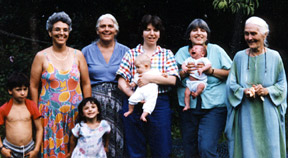
Jennifer will have to help me here, but I think: her sister, her mother( Nancy), Jennifer, unknown, Jennifer’s grandmother. I’m guessing the baby in Jennifer’s arms is her eldest daughter.

View larger image


e.e. cummings – i carry your heart with me

i carry your heart with me (i carry it in
my heart) i am never without it (anywhere
i go you go, my dear; and whatever is done
by only me is your doing, my darling)
i fear
no fate (for you are my fate, my sweet) i want
no world (for beautiful you are my world, my true)
and it’s you are whatever a moon has always meant
and whatever a sun will always sing is you

here is the deepest secret nobody knows
(here is the root of the root and the bud of the bud
and the sky of the sky of a tree called life; which grows
higher than the soul can hope or mind can hide)
and this is the wonder that’s keeping the stars apart

i carry your heart (i carry it in my heart)


inky_black_sm.jpg
View image

Happy Mother’s Day

moms_sm.jpg
Lot’sa moms

Jennifer will have to help me here, but I think: her sister, her mother( Nancy), Jennifer, unknown, Jennifer’s grandmother. I’m guessing the baby in Jennifer’s arms is her eldest daughter.

View larger image


e.e. cummings – i carry your heart with me

i carry your heart with me (i carry it in
my heart) i am never without it (anywhere
i go you go, my dear; and whatever is done
by only me is your doing, my darling)
i fear
no fate (for you are my fate, my sweet) i want
no world (for beautiful you are my world, my true)
and it’s you are whatever a moon has always meant
and whatever a sun will always sing is you

here is the deepest secret nobody knows
(here is the root of the root and the bud of the bud
and the sky of the sky of a tree called life; which grows
higher than the soul can hope or mind can hide)
and this is the wonder that’s keeping the stars apart

i carry your heart (i carry it in my heart)


inky_black_sm.jpg
View image

1952

From Nancy Tomlinson Hall Rice’s (Jennifer’s mother) Senior Paper, October, 1952
Well, so perhaps my need to write, up through my freshman year in college, can be attributed simply to the fact that I wanted to be like my mother, and was copying those things which seemed to be important to her, without having any idea why. Actually I never saw any of my mother’s finished stories. [S]he was always scribbling down little bits of conversations on the backs of envelopes.
Some of these conversations were ones I remembered hearing or being part of myself, and these were always slightly distorted and much more fun the way my mummy had put them down. I tried not to snoop, but the temptation to see something as she had seen it was often too strong to keep me from looking at things she left lying around in the open.
And I began to keep diaries. One summer in particular, as I remember it, I used up seven lined notebooks, [My mother] suggested that I try for brevity. My diary became not so much a record of what my life was like, but a cheerful practice in saying things well.
And I did say things well. My stories, the ones I turned out in the old days, still strike me as cleverly done. I had what my mother called a flair for the dramatic, by which she meant that I told my stories as she told hers. They were complicated and witty, and very little more. It began to seem to me even then, and increasingly my first year in college, that this was dishonest in me.
One of my best stories, published as the lead story in the school magazine my junior year, would be a good example.
My brother Jerry and I had decided one year to tap the maples on our lawn and in the churchyard next door. It was a silly-ish sort of a lark, and Mummy was cross with it all along, because it meant every pan in the house and rows of milk bottles and dishpans (everything but the bathtub) filled with sickish-sweet maple sap, waiting to be boiled on the stove. And it meant no burners for cooking and the house steamy for weeks, but she was a good-ish sort of Mummy and she let us go ahead. The sap came in a rush, and overwhelmed, we went next door to borrow the giant kettle that Mrs. Delarmy used for spaghetti suppers. Sometimes she let the ladies of the Ladies Aid borrow it for Church Suppers, when she could be there to help.
ìIf it were anybody but the Hall children,î we heard her say to her daughter as we left hugging it happily, ìI don’t know as I would have.î And we remembered our promise to be careful, but wondered whatever there could possibly be to be careful about. After all, a kettle is a kettle, and indestructible.
It was not. We left it simmering one night, and woke to find the house a choke of smoke and the kettle a glowing mass of bubbling flames. The bottom, what with the heat from the gallons of sugar, just burned right out. It was wartime and the kettle impossible to replace. Jerry and I still squirm inside when we remember.
As I said, it was a dramatic story, and I told it vividly and with a high-handed amusement. The details, to be technical, were all slightly askew from the truth, but not more so than the details of the writing I do now. But they were askew in a different direction, and for a different reason. They were askew because it sounded funnier that way, and more dramatic, not because I wanted to make them reveal not only what had happened but the way I felt. I had told it to arouse in others first a feeling of amusement and then of shock, and it seemed to me (almost) that this was enough.
Two things nagged at me. First there was Mrs. Delarmy, who might, because she was a good person, have forgiven the kettle, but never, if she had seen it, the story. And then there was my brother. We never talked much, but we understood each other; about the story he said nothing to me, but I knew I hadn’t been true to something the two of us shared.

Faux Americana

Chris, the internet reader, sent me this link . If you have any interest in Bruce Springsteen, it is one of those ìmust reads.î


Susan arrived yesterday as I was putting dinner on the table. Matt did his caged lion act, forced to sit with us twice as long as normal. After dinner, he bolted to Willow Books while we went to – where else? – Ericksonís Ice-cream .

Phantom

phantom.jpg
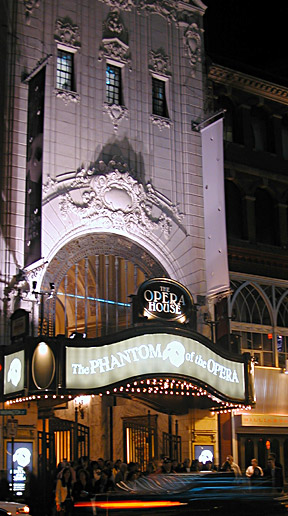
Last night we saw The Phantom of the Opera. In Diane’s words,”Who knew we’d see something so good?” If I were a theater reviewer my column would have one word – “Go.”

Matt brought his friend, Debbie, and we arrived early so we could have dinner before the play. Matt, the skeptic, kept asking me, “So, Dad (my capital), where are we eating?” He knew I had no idea, but he asked the same question every fifteen minutes or so.

We parked in a lot across from The Opera House, and after looking up and the down the street, but seeing no restaurants, I immediately asked the lot attendant for a recommendation. He pointed down the street, past the playhouse, and said,”There are plenty in that direction.” After walking a few blocks and seeing nothing but a Wendy’s and a pizzeria, Matt asked again, “So Dad, where are we going to eat.” I stopped at a sidewalk cart, the vendor selling t-shirts, and popped the question. He said, apologetically, “I only work here.”

We walked another two blocks when Diane spied Kennedy’s Irish Pub and Steak House a block away, up a side street. It was – even Matt had to admit – perfect. I had salmon, Diane crab cakes (not enough crab for Linda), Matt a huge hamburger with barbecue sauce and Debbie a gloppy, cheesy pasta plate. I didn’t say the food was perfect.

On the way home I played Springsteen’s new CD , Devils and Dust. I love it, but I knew Diane would hate it – the repetitive beat, Bruce’s unintelligible mumbling ( far worse than Nebraska), the dirge-like quality (not quite as funereal as Tom Joad) so I kept it low until Matt said, “If you insist on playing horrible music, at least turn it up so we can hear it.”